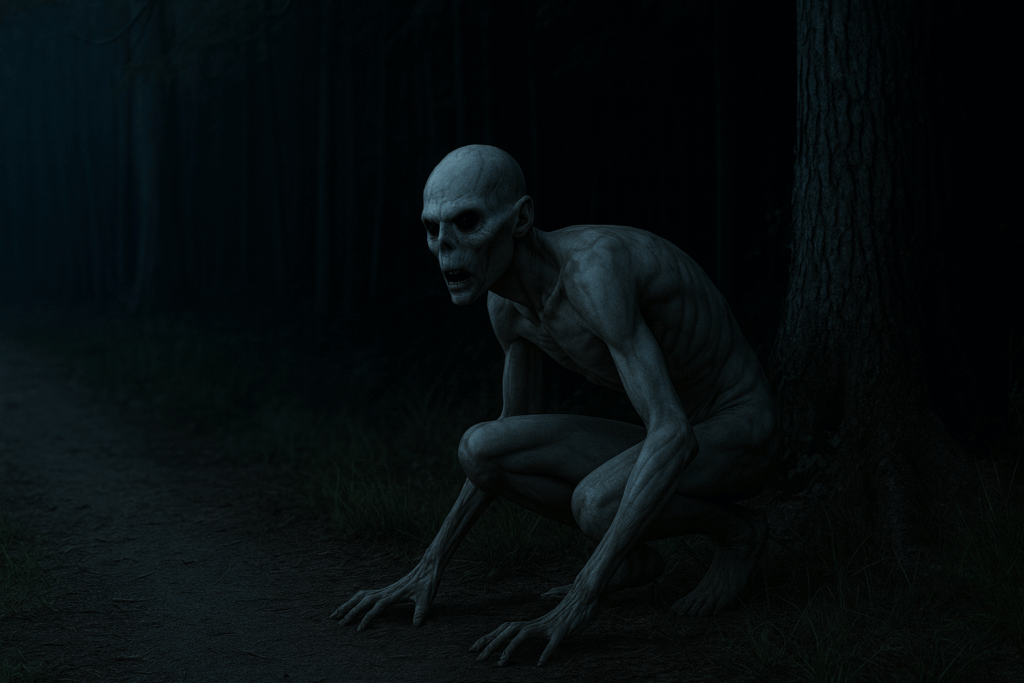
🕳️ THE RAKE / PALE CRAWLER 🕳️
Subtitle: The Emaciated Human Mimic that Hunts at the Edge of Sleep
I. Overview
“You don’t hear it approach. You wake to find it watching.”
The Rake (also known as The Pale Crawler, Sleeper’s Watcher, or White Shadow) is a humanoid cryptid or extradimensional entity most frequently reported in the northeastern United States and the Appalachian region, though sightings extend worldwide.
Descriptions depict a gaunt, hairless figure—humanoid in form but animal in motion—pale gray skin stretched taut over long limbs, with luminous eyes reflecting light like a cat’s. It moves on all fours but has been observed standing upright when stalking prey. The Rake is primarily nocturnal, manifesting near forests, rural homes, and liminal boundaries between wilderness and habitation.
First appearing in online accounts around the mid-2000s, many cryptozoologists dismiss it as internet folklore. However, consistent field reports, physical impressions, and regional encounters dating back to the 1700s suggest something older—a phenomenon predating digital myth.
II. Classification & Taxonomy
| Category | Detail |
|---|---|
| Common Name | The Rake / Pale Crawler / White Shadow / The Watcher |
| Scientific Classification | Genus: Homo tenebris |
| Species | H. vigilans |
| Family | Predatory Hominoids (Nocturnidae) |
| Height | 6–7 feet when standing; 4 feet at quadrupedal stance |
| Coloration | Ash-white to gray; flesh often described as slick or translucent under moonlight |
| Primary Habitat | Rural woodland regions, abandoned properties, drainage tunnels, and forest perimeters |
| Active Period | Strictly nocturnal; most active between 2:00–4:00 A.M. (“The Watching Hours”) |
| Behavioral Type | Lurker / Predator / Observer — possibly parasitic |
Note: The Rake’s consistent association with sleep paralysis, distorted radio frequencies, and emotional distress suggests partial metaphysical or psychic nature rather than purely biological.
III. Physical Characteristics
| Feature | Description | Field Notes |
|---|---|---|
| Stature | 6–7 ft, elongated limbs, disproportionately long fingers | Capable of quadrupedal and bipedal locomotion; gait described as “disjointed yet fluid.” |
| Skin | Pale, hairless, sometimes wet or glistening; often emits faint odor of decay | Thermal scans indicate cold-blooded physiology or ectoplasmic mimicry. |
| Eyes | Reflective white or amber in low light; no visible pupils | Witnesses report “hypnotic gaze” followed by paralysis or panic attacks. |
| Mouth / Teeth | Elongated jaw with numerous needle-like teeth | Victims describe slow, deliberate breathing when creature is near. |
| Hands / Claws | Extremely long digits; capable of gripping vertical surfaces | Scratch marks found 8–9 ft high on trees and walls. |
| Sound Profile | Variable — hissing, rasping, or low sobbing noises | Occasionally mimics human crying or words spoken by previous victims. |
IV. Behavior & Hunting
Predatory Behavior:
- Ambush & Observation: The Rake often precedes attacks with prolonged observation. Witnesses describe waking to see it crouched at the foot of the bed, watching silently for minutes.
- Psychic Disturbance: Victims frequently report vivid nightmares or intrusive thoughts days before sightings.
- Predation Pattern: Physical attacks are rare; most encounters involve extreme psychological trauma, chronic insomnia, or unexplained physical weakness afterward.
- Feeding Theory: Believed to consume emotional or spiritual energy (fear, despair, sleep-deprivation), though some cases involve physical lacerations consistent with feeding attempts.
Social Behavior:
- Solitary creature; no evidence of pack or communal behavior.
- However, reports from dense woodland areas (e.g., Pennsylvania 2017) suggest multiple entities can occupy shared territory without conflict—possible hive or hive-mind correlation.
Cognitive Ability:
- Displays tool-awareness (opening doors, testing latches).
- Possible mimicry of human voice recorded on trail cameras: disembodied whispering, sobbing, or repeating the witness’s own words.
V. Habitat & Territory
| Feature | Description | Field Notes |
|---|---|---|
| Habitat Preference | Forest perimeters near human habitation | “Edge predator” that avoids deep wilderness but feeds near populated zones. |
| Shelter / Nesting | Abandoned homes, tunnels, drainage culverts, or shallow caves | Minimal nesting material; prefers damp, enclosed environments. |
| Territorial Behavior | Highly territorial but non-confrontational | Leaves claw marks on trees or walls; will retreat if light is shone directly on it. |
| Movement Range | Estimated 10–15 miles | May track individual humans across distances; “attachment” phenomena recorded in multiple states. |
VI. Signs of Presence & Encounter Protocol
| Sign | Meaning | Recommended Action |
|---|---|---|
| Scratches or claw marks on trees or siding | Territory marker | Leave area immediately; document only from distance. |
| Low sobbing / whispering near forest edge | Luring or mimicry behavior | Do not investigate; retreat indoors or into vehicle. |
| Repeated sleep disturbances or nightmares of pale figures | Pre-encounter psychic link | Record dream patterns; avoid isolation at night. |
| Sudden silence in forest (loss of insects, birds) | Hunting phase | Shine bright light in 360° sweep; retreat slowly; avoid eye contact. |
| Feeling watched / pressure on chest while sleeping | Sleep-paralysis encounter | Attempt to move fingers and toes; avoid eye contact if entity visible. |
Field Tip: EMF detectors and static microphones often spike before sightings; some field operatives claim reciting names disrupts psychic influence (“naming breaks claim”).
VII. Detection & Documentation
| Method | Description | Notes |
|---|---|---|
| Trail Cameras | Capture pale, hairless silhouette; often distorted or blurred | IR lights sometimes cause aggressive response. |
| Thermal Imaging | Minimal heat signature | Possibly ectoplasmic, absorbs ambient temperature. |
| Audio Recordings | Low-frequency hum, static interference | Rare human-like whispering caught during playback. |
| Soil Impressions | Long, narrow footprints, heel-to-toe with claw marks | 9–11 inches in length; weight distribution inconsistent with human anatomy. |
| Electromagnetic Fields | Fluctuations 4–6 mG | Accompanied by nausea and dizziness in humans. |
VIII. Defensive Measures
- Maintain consistent artificial lighting near sleeping quarters; motion lights recommended.
- Avoid prolonged eye contact — reports indicate psychic paralysis may occur.
- Do not investigate auditory mimicry (crying, whispering, your own name).
- Carry strong light sources — UV and halogen flashlights have disrupted pursuit behavior.
- Record encounters but do not engage; retreat calmly and document from safety.
- Prolonged exposure leads to sleep deprivation, hallucinations, and mental decline — maintain psychological check-ins after any sighting.
IX. Paranormal & Veil Correlations
The Rake displays behaviors consistent with Veil entities—beings that traverse between physical and psychic planes. Witnesses frequently report:
- Static distortion in dreams before physical encounter.
- Chronological gaps or lost time following exposure.
- Shared hallucinations between multiple witnesses, suggesting projected consciousness.
Theories propose that the Rake is a manifestation of human terror feeding on emotional resonance, existing halfway between corporeal and conceptual. Locations with known Rake sightings overlap with high liminal field readings (sleep paralysis clusters, electromagnetic anomalies, paranormal frequency spikes).
X. Field Observations & Anecdotes
Catskills, NY (2009):
Campers reported pale humanoid crawling along treeline; trail cam captured eyeless figure with elongated limbs. All electronic devices failed simultaneously for 43 seconds.
Maine (2013):
Homeowner awoke to scratching on window. Reported figure crouched outside, head cocked, mouth open as if breathing against glass. Dog later found dead, desanguinated.
Pennsylvania (2017):
Three hikers experienced identical nightmares prior to sighting; described being “called by name” in whispers. One suffered complete blackout for 20 minutes; regained consciousness 50 yards from trail.
West Virginia (2020):
Security footage shows entity crawling along wall of barn roof at 3:27 A.M.; thermal readings inconclusive. Witness hospitalized for severe anxiety.
Field Notes: The Rake’s purpose remains unclear. Predation? Study? Parasitism? Every theory collapses when tested—except one: it watches because it wants to be remembered.
XI. Summary
“The Rake is the silence between heartbeats — the shape your fear takes when you finally look under the bed.”
Key Takeaways:
- Pale, hairless humanoid; 6–7 ft; moves quadrupedally and bipedally.
- Observational, psychic predator associated with sleep paralysis and terror.
- Avoid isolation, eye contact, and mimicry responses.
- Maintain strong lighting, document evidence from safety.
- The Rake doesn’t hunt for blood — it hunts for awareness.