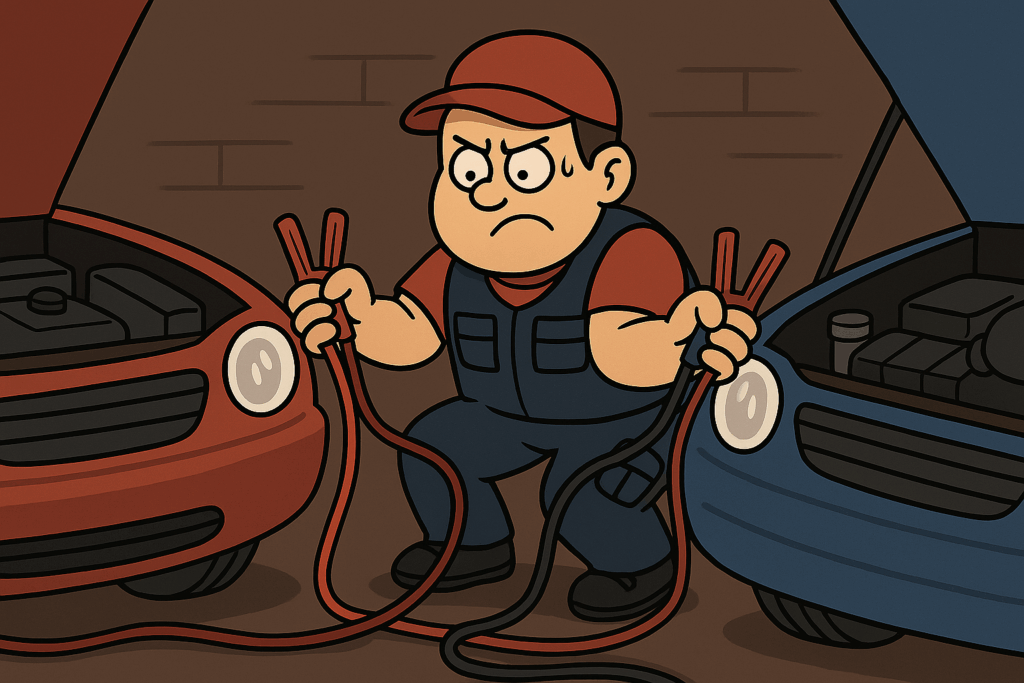
What you need (stop and gather these)
- Jumper cables (heavy-gauge, ideally 4–6 gauge).
- A donor car with a compatible 12V battery (or a dedicated jump-starter pack).
- Gloves and safety glasses (optional, but you’ll look cooler and avoid hand-gnawing).
- Owner’s manuals (for specific battery locations and recommendations).
- Phone to call for help if you ignite anything.
- Estimated time: 10–20 minutes if you don’t panic.
⚠️ QUICK SAFETY CHECKLIST (READ OR BE SORRY) ⚠️
- Do not jump a frozen, cracked, or leaking battery. That battery is toast and dangerous.
- Do not lean over the battery while connecting cables.
- Avoid smoking or open flames nearby. Batteries produce hydrogen gas — which likes to explode.
- Make sure engine accessories (radio, lights, A/C) are OFF on both cars.
- Confirm both vehicles are 12V systems (most modern cars are — trucks/buses may not be).
🧭 Step-by-step 🧭
Step 1: position the cars
- Park the donor car close enough for the cables to reach, but don’t let the cars touch. Engines off. Parking brakes engaged.
- If using a jump pack, just park near the battery and switch it off until ready.
Step 2: prep both vehicles
- Turn off everything electrical (lights, stereo, heater). Remove metal jewelry if you want to keep your fingers.
- Open hoods and find the batteries. Some cars hide batteries in trunks or under plastic covers — check manuals. If the battery terminals are dirty, brush them lightly.
STEP 3: Identify positive (+) & negative (−) terminals
- Positive is usually red or marked “+”. Negative is usually black or “−”. Do not guess. If terminals are hard to reach, consult the manual.
STEP 4: Connect jumper cables (in correct order)
Follow this exact order. It matters.
- Red clamp to dead battery + (the dead car).
- Red clamp to donor battery +.
- Black clamp to donor battery −.
- Black clamp to an unpainted metal ground on the dead car, away from the battery (engine block or a solid bracket). Do not attach the black clamp to the dead battery’s negative terminal if you can avoid it — attach to chassis ground to reduce spark risk.
**If you’re using a jump pack, attach its red to + and black to ground on the dead car (or as the pack instructions say).**
STEP 5: START THE DONOR CAR
- Start the working car and let it idle for 2–5 minutes to charge the dead battery. If the donor car dies or voltage drops drastically, stop and get professional help.
Step 6: TRY TO START DEAD CAR
- Attempt to start the dead car. If it turns over and starts, don’t celebrate like you discovered fire — let both cars idle connected for 3–5 minutes to stabilize.
- If it doesn’t start, wait another minute and try again. After 3 failed attempts, stop and troubleshoot: cables, connections, donor car charge, or a dead battery beyond recovery. Don’t crank continuously — that wrecks the starter.
STEP 7: Remove cables — reverse order you connected them
Remove them carefully in this order:
- Black clamp from the previously dead car (the ground).
- Black clamp from the donor battery (donor −).
- Red clamp from donor battery (+).
- Red clamp from previously dead battery (+).
Keep the clamps from touching each other or ground them on metal while any clamps are still attached.
STEP 8: LET THE JUMPED CAR RUN
- Keep the revived car running for at least 20–30 minutes (or drive it) to charge the battery. Short trips won’t fully recharge — consider a proper charge with a battery charger if you can.
💡 troubleshooting & COMMON PROBLEMS 💡
- It sparks when you connect cables: You probably made a wrong connection. Disconnect everything safely and start over.
- Car starts then dies immediately: Battery may be too weak or alternator might be bad. Get the battery and charging system tested.
- Nothing at all happens: Check cable clamps for good metal contact (no paint, corrosion, or greasy film), ensure donor car battery is charged, and confirm both cars’ switches are in the right positions.
- Donor car stalls while revving the engine: Could be an electrical issue; stop and get help.
EXTRA TIPS & ETIQUETTE:
- If you used someone else’s car, buy them a coffee. It’s the polite thing.
- If your battery is more than 4–5 years old, prepare for replacement — they don’t die gracefully.
- Keep a portable jump starter in your trunk. It’s cheaper than roadside drama.
- If you smell rotten-egg or see bulging or leaking battery casing — stop. Call for assistance.