
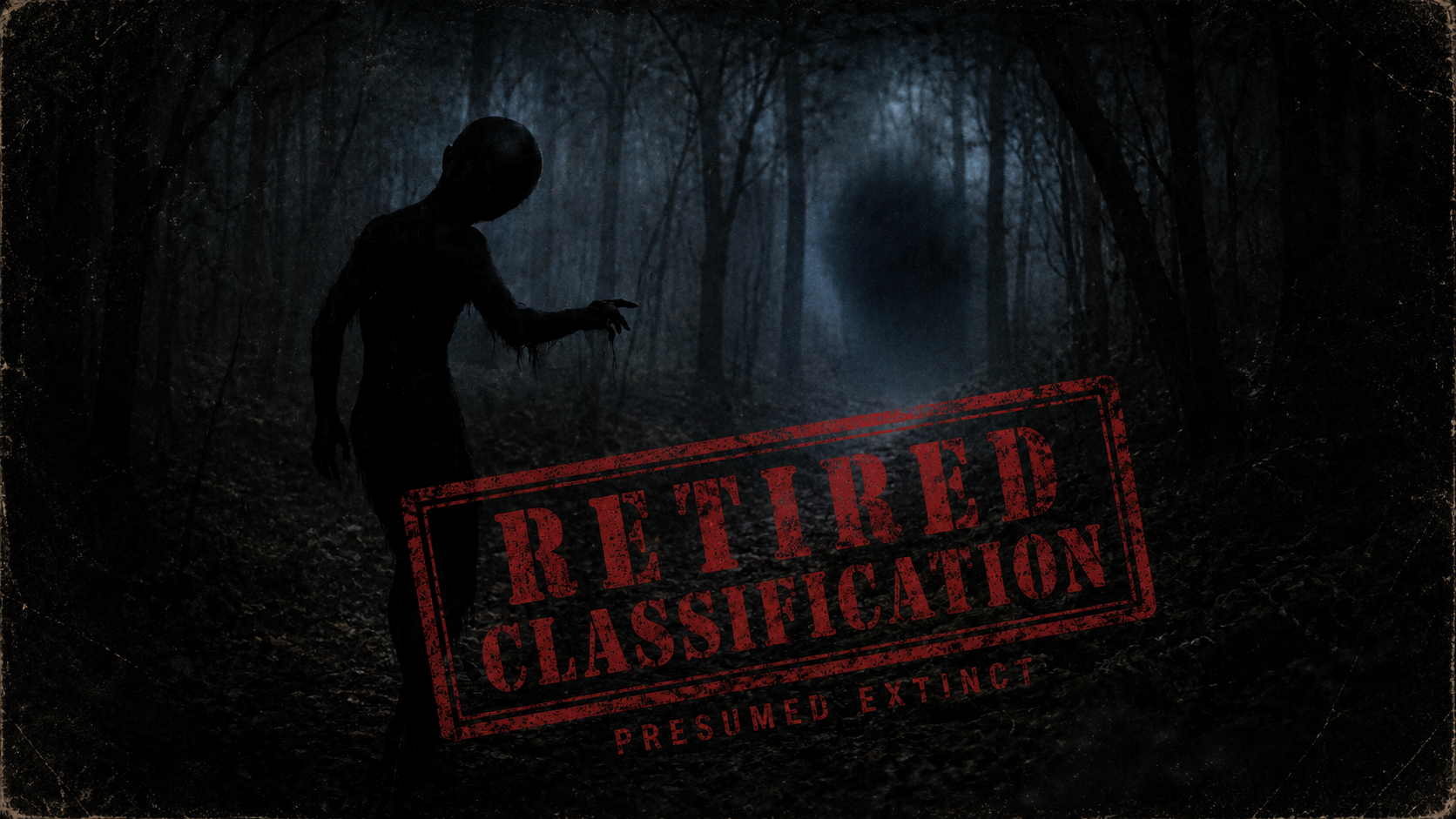
🌫️ VEILKIN 🌫️
Status: Retired Classification / Presumed Extinct
Current Standing: No verified active sightings. Historical reports preserved for archival review.
Subtitle: Retired Liminal Classification, Historical Threshold Reports, and Misidentified Guidance Phenomena
I. Overview
“They don’t chase you. They just make sure you get there.”
Veilkin were once classified by The Everyday Heroes as small liminal entities associated with unstable boundaries, repeated disappearances, abandoned structures, forest thresholds, broken paths, and places where reality appeared to thin.
Early field notes described them as non-aggressive figures that seemed to guide witnesses toward dangerous crossings, unsafe locations, or suspected anomaly zones. They were not believed to be direct predators. Instead, they were classified as facilitators: entities that appeared before or after an event, but rarely during the event itself.
Current review has moved Veilkin to Retired Classification status. No verified active sightings are presently recognized. Some prior reports may represent misidentified shadow phenomena, residual Hushling activity, psychological patterning near thin places, or an extinct branch of liminal ecology no longer observed.
This entry remains preserved for historical research.
Retired does not mean disproven.
It means the original classification is no longer considered reliable.
They were often blamed for disappearances.
They were not the cause.
They were what lead you there.
II. Classification & Taxonomy
| Category | Detail |
|---|---|
| Status | Retired Classification / Presumed Extinct / No verified active sightings. |
| Common Name | Veilkin |
| Scientific Classification | Genus: Liminalis \n Species: L. ductor |
| Family | Liminal Facilitation Entities / Threshold Guides |
| Height | Typically 24–30 inches |
| Origin | Boundary-born entity tied to repeated liminal events and residual disturbance |
| Primary Habitat | Forest thresholds, abandoned structures, broken pathways, stairwells, hallways, and known disappearance sites |
| Active Period | Dusk, night, fog, and periods surrounding liminal instability |
| Behavioral Type | Non-aggressive, lure-based guidance behavior |
III. Physical Description
| Feature | Description | Field Notes |
|---|---|---|
| Build | Small, thin, slightly hunched; subtly disproportionate with narrow shoulders and a slight abdominal weight | Proportions feel intentionally “off,” but physically stable |
| Surface | Matte-black, light-absorbing body; appears like charred material, burnt fabric, or compressed shadow | Does not reflect light normally; reads as absence given form |
| Edges | Mostly solid and defined; minor fraying or degradation at extremities | Fraying resembles physical decay, not mist or energy |
| Face | Smooth, featureless, fully eyeless head; no sockets, no expression | Head tilt replaces expression entirely |
| Arms / Hands | Long, thin, dexterous; fingers used for pointing, beckoning, and gripping surfaces | Hands are highly expressive despite lack of face |
| Movement | Slow, deliberate, physically grounded; may appear repositioned without transition | Moves like it understands space differently, not like it phases through it |
| Sound | Near-total silence; occasional faint dry shifting or contact noise | Silence is consistent and unnatural |
Field Notes: Historical reports consistently describe Veilkin as physically present, matte-black, featureless figures rather than mist, vapor, or shadow distortion. However, current EH review no longer treats this description as proof of a stable active species. The consistency may suggest a now-extinct entity, repeated misidentification, or a shared witness pattern attached to certain liminal environments.
IV. Behavioral Ecology
A. Core Behavior
Historical reports suggest Veilkin did not hunt. They guided.
- Appear at edges of perception (tree lines, doorways, path splits)
- Maintain distance just far enough to be followed
- Reappear ahead of the observer
- Never physically force movement
Their behavior creates the illusion of independent choice.
You are not being chased.
You are being led.
B. Feeding Behavior
Veilkin feed on:
- residual fear
- disorientation
- emotional rupture
- spatial instability
- post-event psychological disturbance
They do not feed on:
- flesh
- direct fear response
- active suffering
Critical Dependency:
Veilkin require external events to generate usable residue.
Primary source:
Former Theory: Early notes suggested Veilkin required external events to generate usable residue. This dependency is now considered unverified.
C. Event Relationship
| Stage | Reported Veilkin Role |
|---|---|
| Pre-Event | Locate thin place and guide target toward it |
| Event | Withdraw completely |
| Post-Event | Return to feed on residual disturbance |
They are almost never seen during the moment something goes wrong.
Only before.
Or after.
Current Review: This event cycle is preserved as part of the original classification model, but it is no longer accepted as confirmed EH doctrine.
D. Temperament
- Non-aggressive
- Non-territorial
- Highly task-oriented
- No emotional display
They do not show:
- anger
- fear
- urgency
They behave like something performing a function.
V. Presence & Psychological Effect
Veilkin do not rely on fear.
They rely on misdirection and quiet intrusion.
Common effects:
- Feeling like a path was your idea
- Repeated visual placement ahead of you
- Subtle environmental misalignment
- A growing sense of being drawn somewhere
In enclosed environments (homes, hallways, rooms):
- Presence feels invasive, not distant
- Often partially concealed (behind walls, doorframes, corners)
- Behavior shifts from guiding → observing proximity before guidance resumes
VI. Origin Theory & RETIRED CLASSIFICATION NOTES
Veilkin are not born.
They emerge where boundaries fail repeatedly.
Suggested Progression:
- Boundary Weakening
Repeated anomalies destabilize an area - Residue Accumulation
Emotional and spatial disturbance lingers - Veilkin Emergence
Entities appear, drawn to available residue - Behavioral Adaptation
They begin guiding living beings toward stronger events - Ecosystem Integration
Older notes proposed a cycle of Guidance → Event → Residue → Feeding. Current EH review considers this model incomplete and possibly contaminated by unrelated thin-place reports.
VII. Habitat & Territory
| Feature | Description |
|---|---|
| Forest Thresholds | Tree lines, path splits, wooded trails |
| Abandoned Structures | Homes, industrial ruins, barns |
| Crossing Sites | Bridges, culverts, drainage areas |
| Repetition Zones | Areas with multiple disappearances |
| Interior Liminal Spaces | Hallways, stairwells, doorways |
Territorial Indicators:
- Repeated sightings in the same location
- Subtle path misdirection
- Objects slightly displaced
- Persistent “being led” sensation
VIII. Detection & Documentation
| Evidence Type | Description |
|---|---|
| Witness Accounts | Being subtly guided off path |
| Peripheral Sightings | Figure appearing repeatedly ahead |
| Path Deviation | Unintentional movement into unsafe areas |
| Environmental Drift | Space feels misaligned |
| Post-Event Presence | Entity observed lingering after disappearance |
IX. Encounter Guidelines
These guidelines remain archived from the original field classification. They are preserved because similar advice may still apply to thin-place encounters, even if Veilkin are no longer considered active.
- Do not follow repeated placements of the same figure
- Do not trust a path that becomes easier over time
- Do not assume you noticed it first
- Do not return to locations with repeated sightings
- Do not attempt to approach or block it
Critical Rule: If you believe you have seen something matching a Veilkin report, do not follow it. Whether the original classification was accurate or not, the location may still be unsafe.
X. Summary
“They do not take you. They make sure something else can.”
Veilkin are a retired Everyday Heroes classification once used to describe small, physically present liminal figures measuring approximately 24–30 inches tall. Historical reports described matte-black, featureless bodies, eyeless heads, silent movement, and repeated appearances near thresholds, abandoned structures, broken paths, and sites of reported disappearance.
Original notes classified them as non-violent facilitators that guided living beings toward unstable boundaries and fed on residual psychological and spatial disturbance. Current EH review has withdrawn this interpretation as an active species model.
Veilkin are now listed as Retired Classification / Presumed Extinct.
Key Takeaways:
- Formerly classified as small liminal guide-entities
- No verified active sightings currently recognized
- Original Drowmire association has been retired
- Reports may represent extinct veil ecology, misidentified phenomena, or contaminated field interpretation
- Entry preserved for archival and historical research
- Retired does not mean harmless
- Do not follow repeated figures, false paths, or impossible movement near thin places