
🕯️ FUZZLES 🕯️
Subtitle: Forest Mimics, Thieves, and Nesters of Curious Treasure
I. Overview
Fuzzles are exceptionally small woodland entities drawn to light, warmth, focused attention, and gentle human presence. They are among the rarest minor liminal beings in the codex, not because they are swift, dangerous, or difficult to trap, but because they appear only under very specific emotional and environmental conditions: safety, calm, curiosity, patience, and invitation without pursuit.
They favor thresholds where comfort meets wilderness: lantern-lit paths, quiet campsites, old porches, mossy hollows, creek roots, garden walls, and hollow logs warmed by the day’s fading heat. Many sightings occur only after long stillness, as though the creature must first decide whether the world is behaving gently enough to enter it.
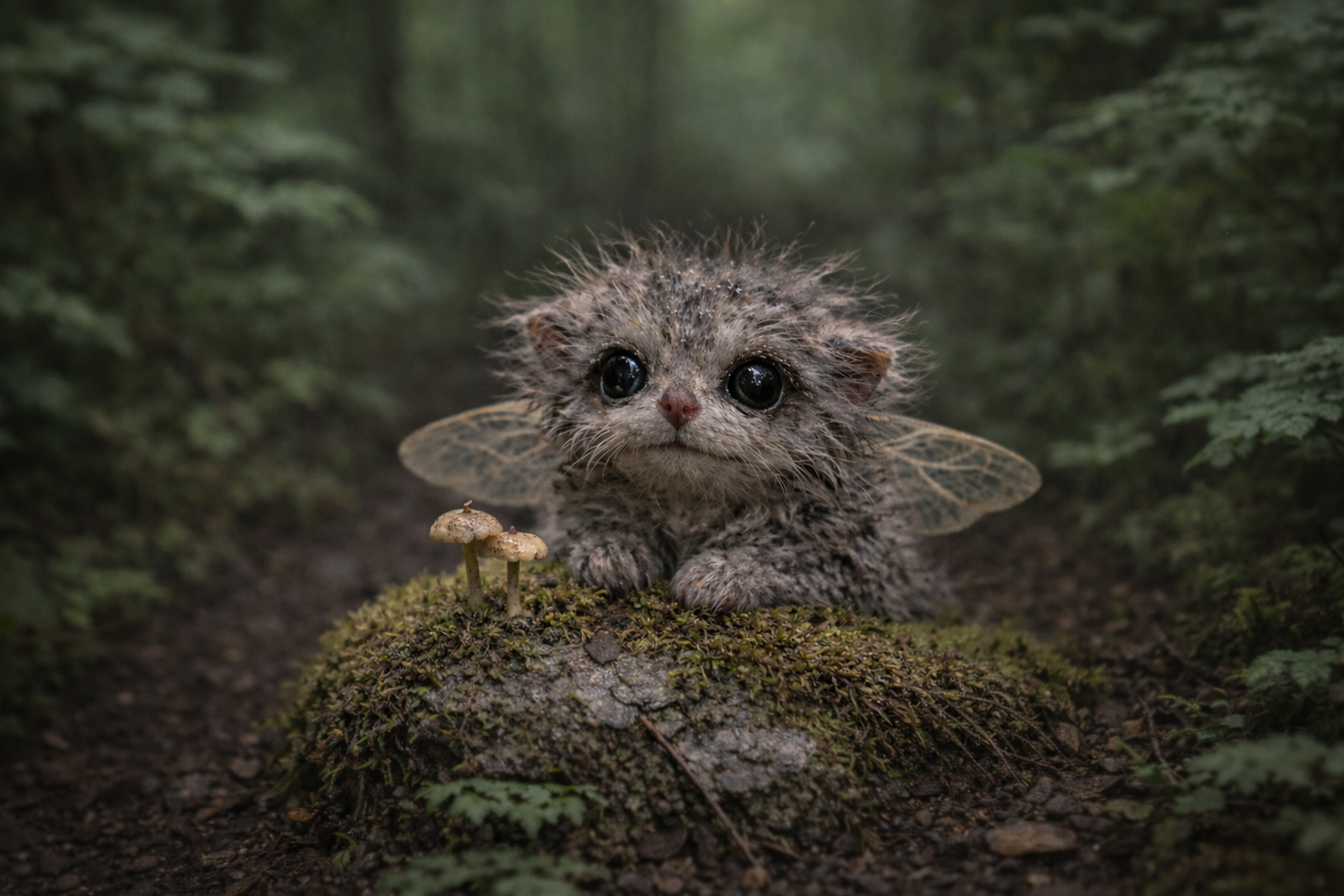
When seen clearly, a Fuzzle is immediately disarming. They appear soft, bright-eyed, delicate, and almost impossibly small, often no larger than a large chipmunk and light enough to rest in the palm of a hand. Witnesses consistently describe them as playful, affectionate, cautious, and oddly trusting, with a tendency to approach warm lanterns, campfire edges, porch lights, open packs, unattended pockets, cupped hands, and quiet observers rather than flee outright.
That first impression is usually accurate.
Fuzzles are not hostile.
They are not predatory.
They are not malicious tricksters hiding cruelty behind cuteness.
A Fuzzle is, by all reliable accounts, genuinely friendly.
Their danger comes from something far stranger and far less intentional.
Fuzzles are intensely social mimics and instinctive gatherers. They watch what people do. They imitate movements, sequences, arrangements, and habits. They copy tone, pattern, repetition, and care. They also collect objects that appear meaningful, beautiful, useful, or frequently handled.
They do so without fully grasping ownership, purpose, consequence, or order.
A human lights a candle to remember.
A Fuzzle learns that flame plus gesture plus focus seems important.
A human draws a boundary for protection.
A Fuzzle learns that tracing shapes on the ground appears to make things happen.
A human repeats a phrase with intention.
A Fuzzle learns that certain sounds belong beside certain motions.
A human keeps reaching for a ring, key, button, charm, or tool.
A Fuzzle learns that this small thing matters very much and may belong in a safer, prettier, or more interesting place.
Because Fuzzles are eager, affectionate, and playful, they repeat these behaviors the way a child repeats a game it does not understand. Incorrectly. Cheerfully. Sometimes alone. Sometimes together.
They steal to mimic.
They steal because they like how certain things look.
They steal because attention leaves a scent of importance on objects.
They steal because arranging treasures together appears deeply satisfying to them.
The result can be harmless, charming, mildly disruptive, or, in rare compounded cases, unnervingly functional in all the wrong ways.
A missing key returned beneath a flower pot beside six polished pebbles.
A wedding ring hidden in a moss nest lined with buttons.
A protective charm relocated to a hollow stump because it “belonged with the other nice things.”
A careful ritual copied badly enough to be foolish, yet well enough to matter.
This mimetic behavior, object-fascination, and associated cognitive drift form the basis of the phenomenon known as Fuzzling.
For this reason, experienced field observers offer one consistent warning:
Never let them watch you do anything important twice.
II. Classification & Taxonomy
| Category | Detail |
|---|---|
| Common Name | Fuzzle – Standard field and folkloric name used across most regions. |
| Juvenile Name | Fip – Common term for young Fuzzles; often used affectionately for playful or immature adults. |
| Recognized Breeds / Types | Mimlet / Tumble – Two widely observed domestic-adjacent morphs distinguished by temperament, habitat preference, and recurring morphological traits including build, coat texture, facial proportions, and coloration. |
| Alternate Names | Lanternling, Snuglet, Tumbletuft, Hollowkin, Trinkle, Pilferpuff |
| Species | Mimiculus sylvanis |
| Known Variants | C. amicus mimletii (Mimlet), C. amicus tumblensis (Tumble) |
| Family | Minor Mimetic Liminal Fauna |
| Entity Type | Woodland Mimic / Object-Collecting Friendly Liminal Entity |
| Average Length | 4–6 inches |
| Average Height | 3–4 inches |
| Typical Weight | Light enough to perch comfortably in an open palm |
| Primary Habitat | Forest edges, mossy hollows, lantern-lit paths, creekside roots, campgrounds, old porches, ruined garden walls, and sheltered places where warmth meets woodland quiet. |
| Active Period | Dusk, twilight, early night, and mist-soft dawn |
| Core Behavioral Traits | Playful, curious, observant, socially imitative, tactile, warmth-seeking, object-collecting, aesthetically selective, mischievous. |
| Known “Collection” Behaviors | Buttons, rings, thread, beads, keys, charms, polished stones, sentimental trinkets, useful nonsense. |
| Threat Level | Very Low individually / Moderate in repeated ritual exposure / Elevated in clustered mimic events – Higher when several agree on a bad idea. |
| Disposition | Friendly, timid, affectionate, dangerously uninformed |
| Variants | Detail |
| Mimlet | Tidier, softer-tempered variety associated with hearths, porches, lanterns, and calm observers. Often more openly trusting. |
| Tumble | Rougher, bolder variety associated with campsites, theft caches, reckless play, and opportunistic scavenging. Charming little criminals. |
Breed Morphology Comparison
| Trait | Mimlet | Tumble |
|---|---|---|
| Build | smaller frame, tidier coat line, finer muzzle taper, tucked ears, lighter-balanced posture. | broader torso, heavier forequarters, rough coat profile, wider face, more exposed ears, spring-loaded hindquarters. |
| Face Shape | Narrower, softer muzzle | Broader face, shorter muzzle |
| Fur Texture | Smooth, plush, groomed | Rougher, tousled, uneven |
| Coloration | Soft tones, lighter hues | Earthier, darker, mottled |
| Ear Visibility | Tucked in fur | More exposed / prominent |
| Movement Style | Delicate, precise | Bounding, forceful, chaotic |
| Breed Movement Distinctions | Mimlets tend toward measured hops, precise footing, controlled hovering corrections, and deliberate repositioning. | Tumbles favor bounding launches, abrupt turns, ricochet movement, rolling recoveries, and momentum with questionable planning. |
NOTE: Juveniles (Fips) may display incomplete breed markers, making early classification unreliable.
ADDENDUM 1: Debate persists whether Mimlets and Tumbles represent subspecies, habitat morphs, or socially reinforced developmental lines.
Field Notes: Fuzzles should be classified through a combination of morphology, coat presentation, movement style, habitat preference, collecting behavior, and mimetic effect rather than by conventional biological logic alone.
III. Physical Description
| Feature | Description | Field Notes |
|---|---|---|
| General Build | Tiny, plush-bodied, compact woodland entities with rounded shoulders, short limbs, oversized eyes, and soft proportions blending small mammal realism with faintly whimsical anatomy. Distinct regional breeds and lines are recognized, most commonly Mimlets and Tumbles. | Their proportions encourage immediate underestimation |
| Size | Usually 4–6 in. long and 3–4 in. tall; juveniles known as Fips are notably smaller. | One of the smallest fully active cryptid entities in the codex |
| Surface / Coat | Dense, ultra-soft fur resembling chinchilla down, rabbit velvet, or weather-fluffed moss. Fur forms plush layers with subtle strand detail, often appearing clean and luminous in Mimlets or rougher and more tousled in Tumbles. | Coat often catches light beautifully, especially around dusk |
| Coloration | Ash-brown, fern-gray, smoke-cream, moss-tan, bark umber, lantern gold, soot-brown, and warm chestnut depending on region, lineage, season, and grooming. | Their fur often reflects environmental warmth more than bright color. Tumbles tend darker or earthier; Mimlets often appear softer-toned. |
| Eyes | Large, dark, glossy eyes proportionally wider than most mammals, highly expressive and reflective in low light. | Witnesses often report an intense but gentle attentiveness |
| Ears | Small triangular or rounded ears, soft-edged and partly hidden in fur, capable of subtle rotation and expressive flattening. | Often flatten or twitch when observing human motion |
| Wings | Fine translucent wings with delicate venation, resembling moth, fairy, or leaf-insect membranes. Usually folded low against the back or sides at rest; opened primarily for hovering bursts, braking, balance, and silent repositioning. | Wings are used more for hovering bursts, balance, and silent repositioning than sustained flight |
| Limbs / Paws | Tiny dexterous forepaws with nimble digits suited for holding, tapping, tracing, sorting, opening, carrying, and stealing objects far larger than logic recommends. Rear feet are spring-light and agile. | Their paws are often seen handling objects with startling delicacy |
| Movement | Quick, playful, stop-start motion combining hops, scurries, short climbs, low glides, hovering corrections, and sudden statuesque pauses. | They often move like something delighted by being alive |
| Vocalization | Tiny trills, breathy chirrs, clicking puffs, sleepy peeps, and soft conversational whistles. | Vocal tones seem social rather than threatening. Groups may murmur quietly while sorting objects or nesting. |
| Scent / Atmosphere | Warm leaves, soft dust, candle smoke, wet moss, dry bark, and the faint smell of cloth drawers or old pockets. | A room or campsite may feel “cozier” before one is noticed |
Field Notes: A Fuzzle rarely appears uncanny at first. It appears precious, soft, and almost implausibly harmless, which is part of why encounters become troublesome later. Humans see softness and assume innocence. Fuzzles see patterns, attention, and unattended valuables.
IV. Temperament & Social Nature
Fuzzles are among the most overtly friendly entities currently recorded in the codex. They do not posture, intimidate, stalk, or threaten. Most sightings involve one quietly watching from a mossy ledge, log hollow, lantern top, porch rail, window edge, or stone near a fire before edging closer in small bursts of trust.
They are curious about people in the way many animals are curious about weather: cautious, observant, and eager when conditions feel safe.
This friendliness appears genuine.
A Fuzzle does not approach to deceive.
It does not charm as bait.
It is not masking predatory intent beneath softness.
It is, by all reliable accounts, sincerely affectionate.
Fuzzles are also not random thieves. Their collecting behavior is deliberate, emotional, and symbolic. They often take objects for reasons humans misread as nonsense but which appear perfectly meaningful to the creature. Items associated with beauty, warmth, repeated handling, sentimental focus, or visible importance are especially prized.
They are not bold in crowded settings and rarely appear around loud, hurried, aggressive, or emotionally volatile people. They seem to prefer quiet gentleness, almost as though safety itself is part of what attracts them.
Common social behaviors include:
- Approaching a calm seated person without fear
- Reaching for warmth, light, or offered fingers
- Watching faces with obvious interest
- Tilting the head in response to tone of voice
- Mimicking simple gestures playfully
- Curling up near lanterns, candles, packs, blankets, or warm objects
- Engaging in small chase or hover games with insects, floating ash, drifting leaves, or dangling cords
- Rearranging nearby objects into clusters, rows, circles, or nests
- Presenting stolen trinkets as if expecting praise
- Resting in groups in sheltered warm micro-spaces, especially hollow logs or root dens
- Following a trusted person short distances before abruptly pretending they were not doing that
Breed temperaments are broadly consistent but not absolute. Mimlets are often calmer, tidier, and more openly trusting, typically approaching with careful pauses and close observation. Tumbles are bolder, rougher, more impulsive, and commonly arrive mid-motion as though already in the middle of a bad decision.
Young Fips display exaggerated versions of all behaviors at once, usually with poor coordination.
Field Notes:This friendliness appears genuine. A Fuzzle is not luring people by pretending to be sweet. It is sweet. Unfortunately, sweetness is not the same thing as wisdom. A creature can adore you and still steal your keys.
V. Visibility & Encounter Conditions
Despite their approachable nature, Fuzzles are very rarely seen. This rarity appears tied to both habitat selectivity and emotional context. They do not seem to emerge for just anyone, nor in places where the atmosphere feels rushed, harsh, chaotic, or overmanaged.
They are most often reported in spaces where comfort overlaps with wilderness: quiet campsites, mossy trail edges, porch perimeters, creek roots, garden walls, lantern paths, hollow logs, and other sheltered margins where warmth meets shadow.
Sightings cluster around environments and moods defined by:
- low noise
- non-threatening curiosity
- warm light
- patient stillness
- careful movement
- solitary or small-group calm
- sheltered woodland margins
- soft twilight conditions
- unattended small belongings
- a general sense that nobody is trying too hard
Witnesses who see a Fuzzle often report that the encounter felt given rather than discovered. The creature may simply appear nearby as if it had been present for some time, watching and deciding.
Searching aggressively almost never works. Waiting quietly sometimes does.
Many encounters begin indirectly:
- a faint movement near a lantern
- a missing button found somewhere impossible
- soft peeping from a stump or root hollow
- objects subtly rearranged during conversation
- the sensation of being politely observed
- discovering tiny paw marks near a pack, pocket, or trinket pile
This has led some field researchers to propose that Fuzzles do not merely avoid danger. They avoid disordered attention. They appear where the world feels gentle enough for play, and where curiosity exists without demand.
Mimlets are more commonly reported near porches, lanterns, garden thresholds, and sheltered domestic edges, where their smaller tidy build blends with orderly spaces.
Tumbles appear more often around campsites, gear piles, open satchels, food tins, and cluttered margins where their rougher coats and bolder movement are less conspicuous.
Young Fips are seldom seen first. They are usually discovered only after an adult retreats toward a den site and reveals a sleeping cluster within.
Field Notes: Trying too hard to find a Fuzzle is one of the best ways not to. They are rare not because they are hidden, but because they seem to prefer being witnessed only under the right conditions. Many sightings end the moment someone decides to prove one is there.
VI. Core Mimetic Trait
The defining characteristic of the Fuzzle is not its appearance, but its intense drive to observe, imitate, and gather.
Fuzzles copy what they witness, especially:
- repeated gestures
- object placement
- hand motions
- flame-lighting behaviors
- tracing or drawing patterns
- spoken cadence
- ritualized sequences
- emotionally focused acts
- routines involving frequently handled objects
- the way humans store, carry, protect, hide, or search for possessions
They also collect what appears meaningful.
Buttons touched often.
Keys reached for repeatedly.
Rings removed with care.
Tools handled with habit.
Objects praised, polished, hidden, mourned over, or searched for.
Unlike malicious mimics, however, a Fuzzle does not imitate to deceive.
It imitates to participate.
This is the critical difference.
A Fuzzle sees humans doing something careful, meaningful, beautiful, or repeatable and assumes it is a kind of game, custom, or communal behavior it may join. If people repeatedly guard an item, admire it, use it ceremonially, or panic when it goes missing, the Fuzzle often concludes that the item is important and should be included in whatever is happening.
The problem is that it has no clear understanding of ownership, sequence, symbolism, or consequence.
It repeats shapes, sounds, and actions the way a delighted child repeats part of a recipe by rearranging the ingredients and forgetting the stove is real.
It steals for overlapping reasons:
- to mimic human attachment
- to possess beautiful or interesting things
- to continue social interaction through objects
- to sort, arrange, and nest meaningful items together
- because repeated attention leaves an aura of importance they seem able to sense
This is usually harmless.
Sometimes it is charming.
A missing key found beside flowers and polished pebbles.
A ring tucked safely into a moss nest lined with thread.
Six spoons arranged by size behind a lantern.
In the wrong context, it is very much not fine.
A protective charm removed from a doorway.
A ritual object placed in the wrong circle.
A candle relit because “that seemed part of the game.”
Three Tumbles collaborating enthusiastically on a terrible idea.
That is the central hazard of the species.
VII. Cognitive Effect: “Fuzzling”
The obsolete term fuzzle once referred to intoxication, confusion, or befuddlement. In modern field use, Fuzzling describes the subtle cognitive disruption associated with prolonged Fuzzle proximity, repeated exposure, or sustained interaction with active nests, theft caches, or mimic events.
Unlike panic, possession, or overt psychic assault, Fuzzling is soft, social, and strangely companionable. It feels less like being attacked and more like having one’s thinking gently nudged out of alignment by an adjacent mind trying very hard to follow along.
Many witnesses report that the effect increases when multiple Fuzzles are present, especially during communal sorting, repetitive mimicry, or periods of excited object gathering.
Early signs:
- forgetting why you stood up
- losing track of simple step order
- repeating a motion you already completed
- speaking the first half of a thought twice
- mild dreamy distraction
- misplacing small personal items
- briefly checking the same pocket twice
Moderate signs:
- fragmented concentration
- object misplacement
- forgetting whether a candle was lit, a door latched, or a phrase already spoken
- copying another person’s wording without noticing
- drifting away from task sequence
- rearranging nearby objects without remembering doing so
- checking caches, bags, drawers, or packs repeatedly
Advanced Fuzzling:
- circular procedural thinking
- inability to keep ritual steps in correct order
- persistent uncertainty about what already happened
- involuntary behavioral repetition
- sensation that thought is “lagging behind itself”
- strong urge to sort, group, or arrange nearby items
- participating in obvious nonsense because it suddenly seems reasonable
Witnesses often describe it not as frightening, but as gently wrong. That low alarm profile makes it more dangerous than a harsher effect would be.
Working Theory: Fuzzling may be a byproduct of proximity to minds built for playful imitation, communal attention, and object-pattern association rather than structured reasoning. The human brain, exposed long enough, begins slipping into the same pattern.
VIII. Habitat & Preferred Environments
| Habitat Type | Description | Field Notes |
|---|---|---|
| Mossy Forest Edges | Soft transitional places where light catches roots, stones, mushrooms, and low growth. Often near paths or human-used margins without heavy disturbance. | Most common general sighting type. Fuzzles favor places where wilderness meets gentle routine. |
| Creek Banks & Water Margins | Calm waterside areas with reflective light, damp earth, exposed roots, and sheltered stones. | Frequently linked to lantern attraction, reflective curiosity, and polished-object gathering. |
| Campgrounds | Especially quiet camps with small fires, unattended gear, repetitive routines, and patient observers. | Strongly associated with Tumbles. Repeated human behavior and loose valuables increase activity dramatically. |
| Porches & Garden Walls | Warm thresholds between domestic safety and surrounding dark, often containing flowerpots, lanterns, tools, and forgotten objects. | Common in folklore accounts. Mimlets are more often reported in these spaces. |
| Hollow Logs / Root Shelters | Primary resting dens for individuals, pairs, family groups, or clustered Fips. Interiors are lined with moss, fur, leaves, thread, and stolen trinkets. | One of the best places to discover nests, sleep clusters, or hidden caches. Approach gently unless you enjoy chaos. |
| Shrines / Memorial Corners | Candlelit, decorated, or softly maintained places marked by repeated intentional acts and emotionally valued objects. | High-interest zones for observation, mimicry, and unauthorized item relocation. |
| Ruined Garden Walls | Old stone edges, ivy breaks, collapsed borders, and forgotten domestic spaces being reclaimed by growth. | Favored for concealed movement, sun-warmed cracks, and salvage opportunities. |
| Tool Sheds / Open Outbuildings | Quiet human storage spaces containing metal objects, cloth, string, pockets, and countless terrible temptations. | Theft reports disproportionately high. Usually blamed on family members first. |
Fuzzles appear especially drawn to places where the environment feels small, warm, interesting, and loosely supervised.
IX. Behavioral Ecology
A. Attraction Patterns
Fuzzles are strongly drawn to:
- candlelight
- lanterns
- fireflies and glowing insects
- campfires and cookstove warmth
- warm hands, blankets, coats, and recently occupied bedding
- patient voices and gentle conversation
- soft music, humming, whistling, or repetitive melody
- repetitive, careful motions
- arranged objects, sorted piles, and neatly placed tools
- shiny trinkets, polished metal, buttons, beads, thread, rings, keys, and pocket items
- open packs, unattended pockets, half-unpacked gear, and loosely supervised belongings
- low-lit interiors visible from woodland margins
- porches, windows, tents, and thresholds where indoor comfort meets outdoor dark
- emotionally significant objects receiving repeated attention
- calm people who seem likely to forgive them
Warmth and meaning appear equally attractive to them. When both are present, activity often increases sharply.
B. Play Behavior
Witnesses frequently describe Fuzzles as playful in specific, repeated ways:
- batting at floating ash, sparks, or drifting seeds
- chasing illuminated insects or reflections
- copying hand motions with tiny paws
- rearranging pebbles, petals, twigs, thread, buttons, or wax drips into deliberate little patterns
- sitting in lantern handles, windowsills, packs, boots, or atop warm objects
- engaging in hide-and-watch games from logs, roots, bags, and moss ledges
- stealing small unattended objects only to leave them later in visible near-matching arrangements
- carrying items far too large for their body with unreasonable determination
- presenting stolen trinkets as gifts, trophies, or social offerings
- sneaking into campsites to inspect belongings while observers sleep
- curling up in groups around especially prized objects as though guarding treasure
- pausing mid-theft and freezing if noticed, apparently convinced invisibility has occurred
- Breed Play Contrast
- Mimlets often sort, stack, align, and present objects.
- Tumbles drag, launch, scatter, hide, and relocate objects with reckless enthusiasm.
C. Group Dynamics
Groups of Fuzzles are uncommon but significant. Small clusters appear cooperative, affectionate, and highly responsive to one another’s imitation. They also share enthusiasm quickly, which is often worse.
This creates the risk of compound mimicry, where one Fuzzle copies a gesture, another copies object placement, another repeats associated sound or timing, and a fourth steals something essential halfway through.
Groups may also form communal caches, sleep piles, or sorting circles where objects are arranged by color, shine, shape, smell, or logic known only to them.
Young Fips in groups are especially chaotic, combining poor coordination, intense curiosity, and no respect for sequence.
What begins as communal play can become accidental reconstruction, synchronized theft, or procedural nonsense with surprising momentum.
D. Threat Profile
Individually, Fuzzles are functionally harmless in direct physical terms. They bite rarely, defend weakly, and show no meaningful predatory drive.
Their threat exists almost entirely in:
- cognitive drift
- procedural interference
- object disappearance at critical moments
- accidental reenactment of meaningful actions
- theft of protective, sentimental, or necessary items
- compounded mimic events in groups
- escalating nonsense reinforced by mutual enthusiasm
A single Fuzzle is usually a curiosity.
Several Fuzzles with free time and access to your belongings are another matter entirely.
X. Ritual Interference & Accidental Function
This is the point where the codex stops calling them adorable and starts checking whether anything important has gone missing.
A Fuzzle does not know what a protective circle is.
It does not know what a summoning gesture is.
It does not know why salt goes there, why the phrase must be spoken first, why the candle must not be moved, why that object stays shut, why the key must remain nearby, or why that heirloom was being used at all.
It only knows:
- you did something carefully
- you did it more than once
- it seemed important
- everyone kept looking at those objects
- maybe it can do it too
- maybe those pieces belong with the other nice things
A Fuzzle imitates process the way it collects valuables: enthusiastically and without context.
Most accidental imitation produces only minor disturbances:
- crooked circles
- misplaced objects
- harmless repetitive tapping
- flickering lights
- changed arrangement of ritual materials
- keys, rings, candles, or charms relocated mid-procedure
- confused witness memory about sequence
- ceremonial items discovered later in a moss-lined cache
Sometimes it is merely irritating.
Sometimes it is funny later.
Rarely, especially where multiple Fuzzles have observed the same process repeatedly, a fragmented imitation can become partially functional.
Not correct.
Not stable.
Not intentional.
But active enough to matter.
Groups are especially hazardous. One copies the gesture. One repeats the sound. One moves the object. One steals the missing piece and hides it beautifully.
That is the Fuzzle’s central danger.
They do not mean harm.
They simply cannot distinguish between important, interesting, and playful.
XI. Detection & Documentation
| Evidence Type | Description | Reliability |
|---|---|---|
| Direct Sighting | Small winged furred figure observed near light, warmth, campsites, porches, or unattended belongings. | Rare but highly distinctive |
| Rearranged Small Objects | Stones, petals, wax, twigs, thread, buttons, keys, beads, rings, or offerings moved into deliberate near-patterns. | Very common at active sites |
| Missing Then Returned Items | Small objects vanish briefly, then reappear in visible, decorative, or nonsensical placements nearby. | Strong supporting sign |
| Shared Forgetfulness | Multiple witnesses losing track of simple sequence, object placement, or recent actions. | Strong supporting sign |
| Light Anomalies | Soft unexplained flicker, relight behavior, lantern tapping, or candle disturbance. | Moderate |
| Tiny Print or Paw Marks | Delicate disturbances near ash, wax, moss, dust, packs, or trinket piles. | Rarely clear, but valuable |
| Theft Cache Discovery | Hollow logs, root dens, wall gaps, or stumps containing clustered stolen objects arranged by unknown logic. | Extremely significant |
| Repeated Gesture Echo | A Fuzzle visibly copying finger, hand, sorting, or tracing motions. | Extremely significant |
| Soft Social Vocalizations | Tiny peeps, trills, clicking puffs, sleepy chirrs, or conversational murmurs near a calm lit area. | Supporting sign only |
| Sleep Nest Presence | Moss-lined hollow containing clustered Fips, feathers, thread, and warm stolen comforts. | Rare but definitive |
Breed Identification Signs
Likely Mimlet Signs
- objects grouped by size or color
- items returned intact
- neat thread or bead nests
- soft repeated observation from nearby perch
Likely Tumble Signs
- scattered cache piles
- muddy stolen objects
- dragged items larger than practical
- opened packs or disturbed tins
- rapid movement followed by fake stillness
Best Documentation Practices
- write everything down immediately
- use sequence logs for repeated tasks
- photograph object arrangements before touching anything
- avoid demonstrating symbolic actions repeatedly in their presence
- keep only one observer interacting at a time
- note whether the environment felt unusually calm, cozy, or mentally unfocused before the sighting
- inventory all small valuables before and after the encounter
- check pockets, packs, rings, keys, and tools before accusing companions
- mark the original position of moved objects prior to recovery
- search nearby hollow logs, root gaps, lantern bases, and sheltered corners for caches
- do not reward theft by dramatically chasing the creature
- if an item is returned, document where and how it was placed note whether Mimlets, Tumbles, or Fips were present, as group composition affects behavior
- if multiple Fuzzles are active, reduce visual stimulation and simplify the environment
- extinguish unnecessary flames and secure ritual or sentimental objects
- record sounds such as peeps, trills, tapping, or coordinated chittering
- if confusion begins, rotate observers and verify task steps aloud
- leave the site calmer than you found it; agitation tends to prolong activity
XII. Encounter Guidelines
- Stay calm and gentle. Fear or aggression usually ends the encounter.
- Do not grab unless absolutely necessary. Their trust should not be punished for your curiosity.
- Do not perform rituals, wards, invocations, or careful symbolic actions in front of them.
- Do not treat mimicry as a game once repetition begins.
- Do not leave meaningful arrangements accessible overnight.
- Do not assume a copied pattern is inert because it is sloppy.
- If more than one Fuzzle is present, reduce visual demonstration and end the interaction quickly.
Safe Interaction Guidance
Acceptable low-risk behaviors include:
- quiet observation
- stillness
- gentle speech
- allowing voluntary approach
- offering warmth through passive presence rather than handling
- documenting without repeated demonstration
- sitting calmly near a lantern, fire, or soft light source
- allowing the creature to inspect harmless belongings without interference
- slowly redirecting stolen nonessential items through trade or distraction
- offering safe curiosities such as buttons, polished stones, thread, or beads in place of important objects
- keeping movements slow, predictable, and unthreatening
- permitting group Fips to rest undisturbed if a nest is discovered
- speaking aloud while performing ordinary tasks so observers do not imitate in silence later
- securing dangerous, sentimental, or ritual objects before interaction begins
Avoid:
- grabbing, cornering, or chasing
- performing symbolic gestures repeatedly
- rewarding theft with frantic attention
- exposing them to traps, glue, chemicals, or loud devices
- allowing access to keys, medicines, fire sources, heirlooms, or protective items
- assuming returned objects are in their original condition or placement
Field Tip: A Fuzzle is best treated like a tiny trusting guest in a room full of switches it absolutely must not learn how to use. If it steals something important, remain calm. Panic is entertainment.
XIII. Folkloric Interpretation
Regional traditions treat Fuzzles with unusual affection for a liminal species. In many stories they are considered:
- hearth-followers
- shy lanternlings
- keepers of small comforts
- forest playthings with borrowed manners
- tiny companions of warm places
- little observers who love people more than they understand them
- pocket-thieves of no real malice
- bringers of lost buttons and found laughter
- guardians of lonely porches
- borrowers who return things improved, delayed, or confusingly decorated
That affection is usually paired with one warning repeated in different forms:
Never let them watch you do anything important twice.
Other common sayings include:
- Lock your door if you must, but lock your pockets first.
- If it goes missing kindly, suspect a Fuzzle.
- Where the lantern glows twice, something small is learning.
- Count your rings before bed.
- If the soft one watches, guard your rings. If the rough one arrives, guard everything. A Mimlet borrows kindly. A Tumble borrows loudly.
In some traditions, a Fuzzle appearing near a lonely person is considered a blessing of gentle company. A Mimlet near the doorstep is said to herald peace in the home. Hearing Fips sleeping in the wall or log pile is taken as a sign the land feels safe.
In others, finding several Tumbles gathered around a campsite is treated as a warning that loose belongings, food tins, and common sense should be secured immediately.
Finding several Fuzzles gathered around a ritual site is considered a sign that the place has become unsafe through repetition and should be cleared, simplified, and rested.
Some rural stories claim a returned stolen item brings luck if accepted with gratitude, and continued harassment if accepted with anger.
They are loved in folklore for the same reason they are feared in field notes:
They are sweet enough to invite in.
And curious enough to rearrange your life once inside.
XIV. Summary
Fuzzles are tiny, rare, warmly social woodland mimics drawn to light, calm, warmth, attention, unattended belongings, and gentle human presence. Roughly the size of a large chipmunk, they are soft-furred, winged, playful, and outwardly friendly, with no evidence of malice or predation. They appear under unusually quiet, safe, and patient conditions, and are so rarely seen that many witnesses describe the encounter as a gift rather than a discovery.
They are not merely mimics, but gatherers. Fuzzles collect what seems meaningful, beautiful, useful, or loved. Buttons, rings, keys, thread, charms, polished stones, sentimental trinkets, and practical necessities are all liable to vanish into moss nests, hollow logs, porch gaps, or communal caches for reasons that make perfect sense only to them.
Their danger lies not in aggression, but in playful imitation and possessive curiosity without comprehension. A Fuzzle copies what it sees in order to join, not to deceive. It steals what it notices in order to participate, preserve, admire, sort, or keep near. That impulse can produce the cognitive drift known as Fuzzling, along with accidental reenactments of human behaviors, rituals, and patterned acts.
One Fuzzle is usually harmless. Several, exposed to the same repeated action or left unsupervised among important objects, can become procedurally dangerous without meaning to be.
Mimlets are smaller-framed, tidier-coated, gentler threshold-dwellers drawn to warmth, order, and trusted proximity.
Tumbles are broader-bodied, rough-coated opportunists of campsites and gear piles, marked by bolder movement, impulsive theft, and durable confidence unsupported by judgment.
Their young are called Fips, and are capable of creating chaos disproportionate to body mass.
They are not wicked little things.
They are not false friends.
They are not bait wrapped in fur.
They are friendly.
They are curious.
They are very, very small.
And they learn by copying whatever looks important.
Then they hide it somewhere safe.
Which is adorable right up until it isn’t.